
Browse docs
Selling and Distribution
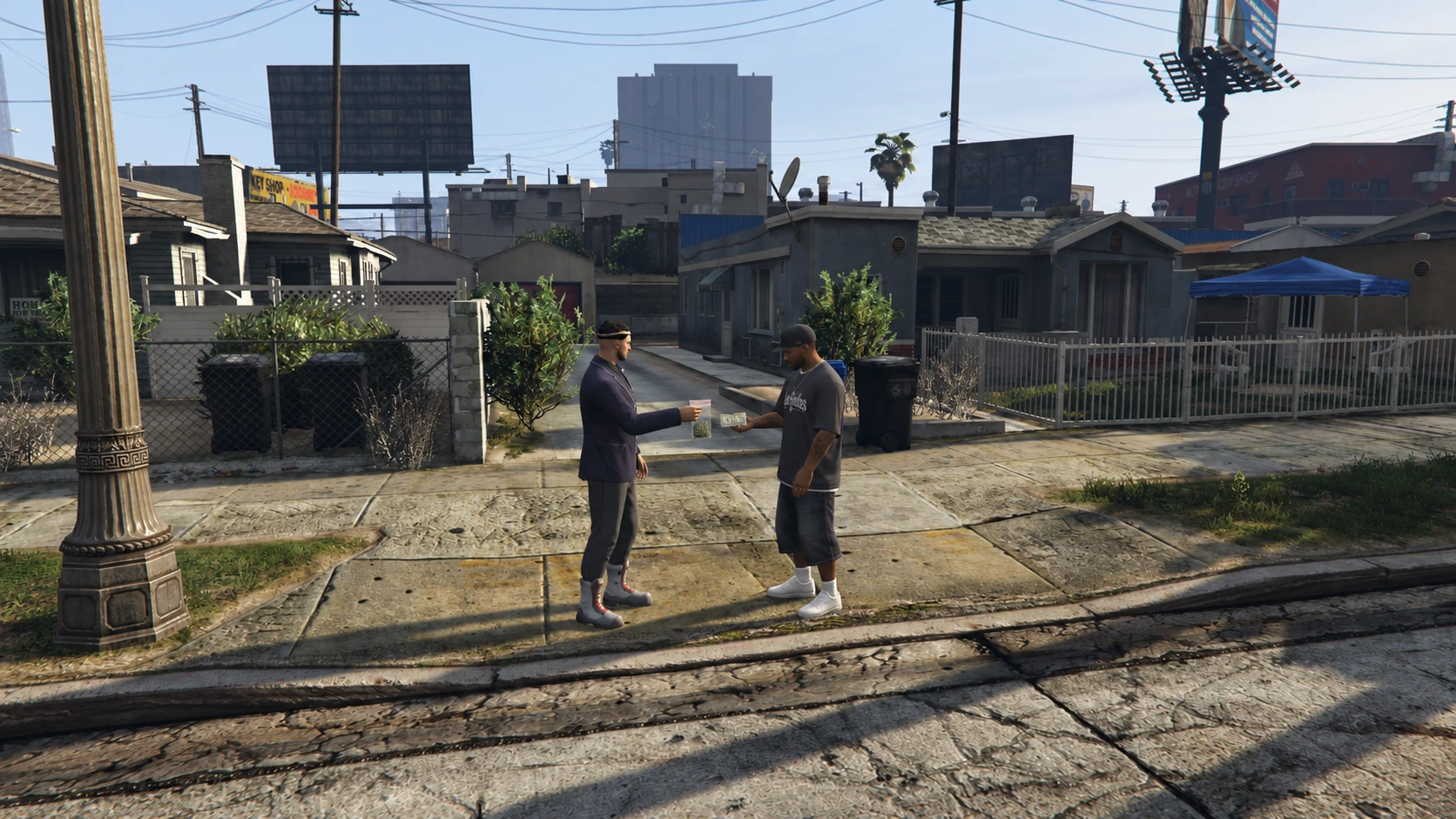
Distribution turns finished inventory into an offer, delivery or street interaction. Buyer rules, quantity, quality, risk and payout are evaluated together.
Start with one way to sell
Start with street sales, then add other options.
| Option | What the player does |
|---|---|
| Street sales | Offers goods to a nearby NPC and negotiates |
| Buyer contacts | Builds a relationship and fulfills requests |
| Dealers | Leaves stock with a dealer to sell over time |
| Delivery routes | Transports goods to a destination |
| Business network | Manages staff, hubs, deliveries, and contracts |
Set up street sales
In /jobconfig → Crime System, check Drug Market → Market Enabled. Then open /drugcreator → Market → Street Sales → Ambient Street Sales (street_sale_default).
Enable the street-sale entry
Under General, keep street_sale_default enabled.
Configure the interaction
Under Interaction setup, verify the key, distance, and permitted NPC models.
Match available stock
Under Trade rules, choose a quantity range players can meet with the finished product.
Review outcomes and risk
Check Customer outcomes and Heat and police risk, then save and reopen the entry.
Buyer profiles determine what the NPC wants and how it reacts. For a first sale, keep an accessible profile such as Market → Buyers → Casual Street Buyer (buyer_street_random). Its Ambient appearance settings must allow it to appear as a street buyer.
Test with a simple finished product, such as weed_baggy. Approach a suitable NPC, offer the product, and complete the dialogue.
Buyers can refuse, negotiate, scam players, or report the encounter. Test several interactions.
After a successful sale, confirm that the stock decreases and the intended money account receives payment. The usual drug-sale payout account is black_money, but individual systems can use different accounts.
Match the buyer to the product
A buyer may care about quality, freshness, contamination, packaging, or quantity.
For example, a premium buyer expects better stock than an ordinary street buyer. A bulk buyer may require a larger package. Raising the product price does not make unsuitable stock acceptable.
Open Market → Buyers → Demand profile and compare these requirements with the product players can actually produce. Use Budget and behavior for spending and reactions. For a starting buyer, avoid requirements that a new player's production setup cannot meet.
If stock is unavailable for sale, also check whether it is already assigned to a dealer or delivery.
Set up a delivery route
Open Market → Sale Routes and select a route.
Define the cargo
Under Route and cargo, set accepted drugs and the quantity range.
Balance payout and risk
Check payment, duration, police requirements, and alert chance.
Configure transport
Under Drop-off and vehicle, verify the delivery area and vehicle restriction.
Place contacts and locations
Configure NPC contacts and Positions, save, and visit both points before testing the route.
Visit both points yourself. Make sure the required vehicle is obtainable and the required number of police can realistically be on duty.
Large packages can contain several sale portions when their product definition configures that amount. The supplied weed_premium_jar currently has no such product mapping and therefore counts as one inventory item and one sale portion. Its recipe consumes five weed_cured, but that input amount does not make the finished jar five delivery units.
Test the entire route as a player: start, travel, deliver, lose the correct stock, and receive payment.
Optional: contacts and dealers
Players discover contacts through activities and referrals. Trust affects information and offers; rumored contacts may not yet accept deals.
Make the intended discovery tools or activities available. If you use the dealer guidebook, provide its configured item, dealer_guide_book.
Dealers sell assigned stock over time and keep a commission. Open Market → Dealers: Distribution setup controls the sale mode, commission, quality requirement, and payout account; Trust and capacity controls access and how much stock the dealer can handle. Players should not expect an immediate payment when assigning stock.
Hired dealers also have upkeep. Include pay and protection in the expected cost of running the operation.
For a first dealer test, assign a small amount, wait for its sale cycle, and check the remaining stock and payout after commission.
Optional: changing market prices
Demand can change with supply, repeated sales, local conditions, and market events. Saturation means that selling too much into the same market reduces demand or price.
When testing prices, use comparable products and buyers. Quality, packaging, location, demand, and dealer commission can all change the final offer.
Set product base prices under Foundation → Drugs → Market. Compare the sale income with material costs, packaging, production time, equipment upkeep, and expected losses.
Optional: a larger business
The business network adds staff, storage hubs, routes, contracts, and progression.
Before making larger contracts available, ensure players can produce the required stock and reach the delivery locations. Review wages, transport costs, deadlines, and failure penalties alongside the rewards.
Use Quality, Consumption, and Risk to understand the other factors that affect product value and operational risk.